MERCHANTS OF EMPIRE: THE MARWARI MAKING OF COLONIAL CALCUTTA
Colonial Calcutta was not only the administrative capital of British India until 1911 but also a crucial node in the global circuits of imperial capitalism. While British firms dominated formal political authority, the everyday functioning of the colonial economy depended heavily on indigenous commercial communities. Among these, the Marwaris – merchant-financiers originating from the Marwar region of Rajasthan – emerged as one of the most influential groups shaping the economic, architectural, and political life of the city.
This essay explores the interlinked arenas of Marwari influence: their mediation of colonial capitalism and their remaking of the urban fabric—especially in Burrabazar, the mercantile heart of indigenous Calcutta.
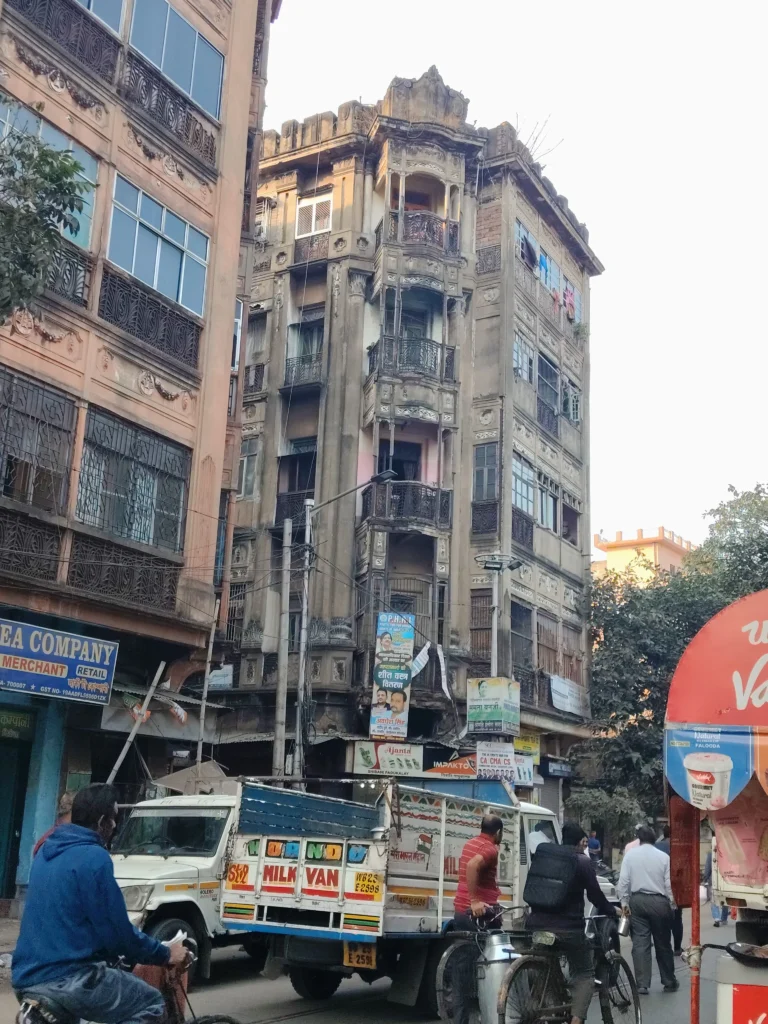
Marwari heritage and Burrabazar’s trading spirit meet in these timeless old mansion
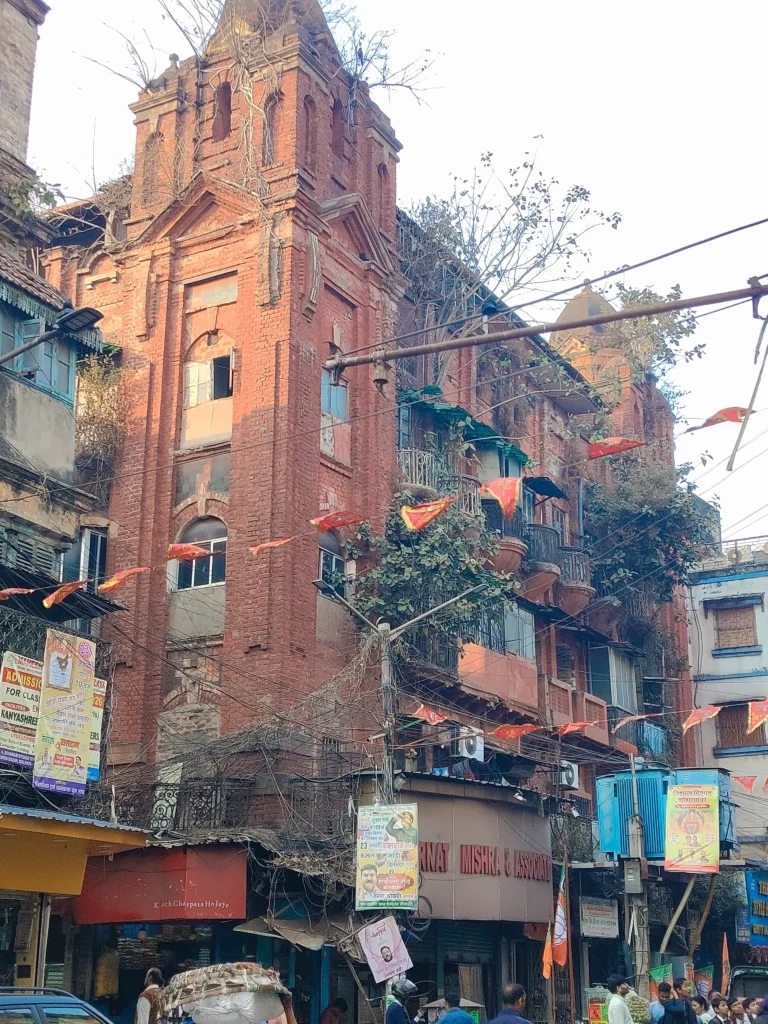
The iconic red-brick building stands as one of Burrabazar’s most striking slices of colonial-era charm
Migration and the Making of a Commercial Ecology
Marwari migration to eastern India accelerated in the early nineteenth century as British power consolidated in Bengal. Attracted by expanding markets under the East India Company, Marwaris established themselves as brokers, bankers, and wholesalers dealing in grain, cotton, jute, and opium. Burrabazar became their principal base – a dense enclave of trade, finance, and residence embedded within the colonial metropolis.
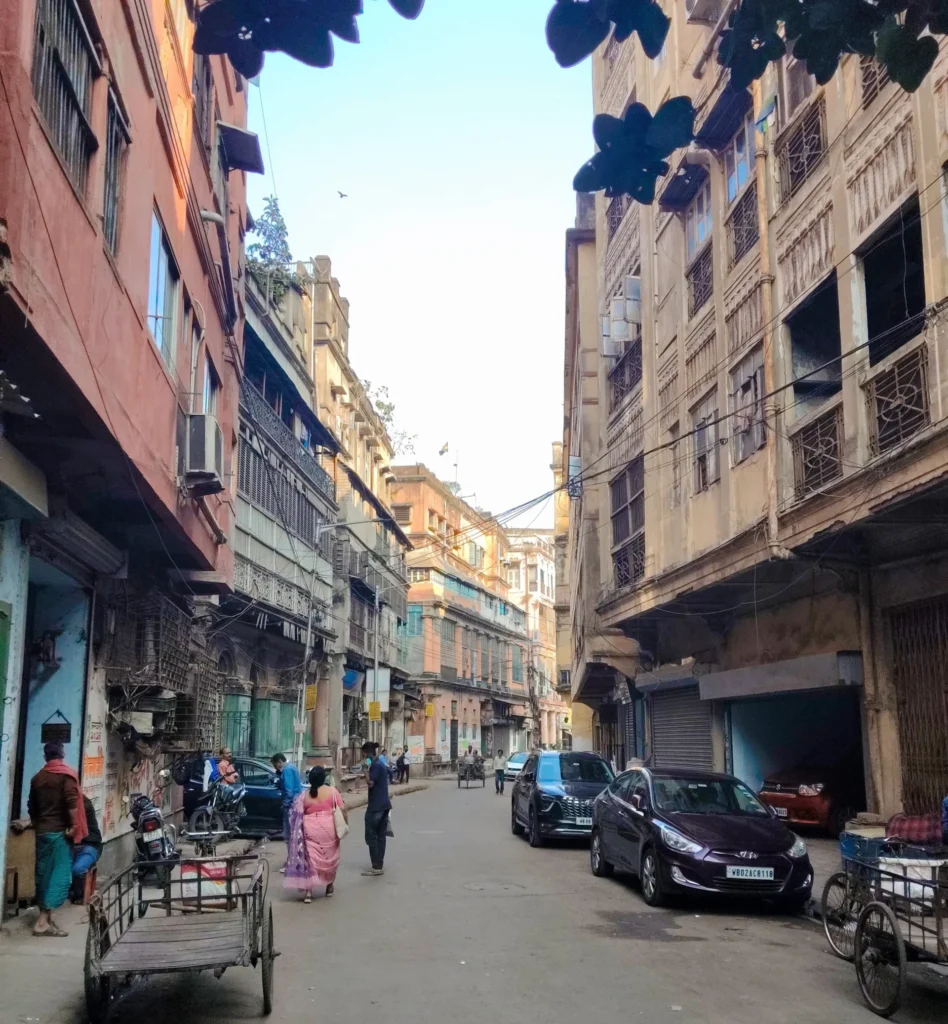
The ornate facades of old Marwari houses line this quiet Burrabazar lane, echoing a legacy of craft, commerce, and community
As C.A. Bayly has shown, indigenous merchant capital was not displaced by colonial rule but rather reconfigured to serve imperial markets.[i] Marwari traders exemplified this process: operating through kinship-based trust networks, hundi credit systems, and interregional connections, they enabled the circulation of capital in ways that often bypassed colonial banking institutions.[ii]
By the late nineteenth century, sections of the Marwari elite transitioned from intermediary trade to industrial ownership. Tirthankar Roy notes that this shift marked a critical phase in Indian capitalism, as merchant groups reinvested profits into manufacturing, especially jute and textiles in Bengal.[iii] This transformation altered the ownership structure of colonial industry and laid the foundations for Indian industrial capitalism.
Marwari wealth reshaped Calcutta’s built environment in ways distinct from imperial monumentalism. Where the British erected grand administrative buildings, Marwaris created dense, functional spaces—godowns, havelis, temples, schools, and dharamshalas—integrated into everyday economic life.
These structures fused storage, residence, worship, and negotiation within single compounds. Architecture was not symbolic display but a working system supporting trade, kinship, and community governance.
Burrabazar: The Mercantile City within a City
Burrabazar emerged in the nineteenth century as the principal commercial quarter of indigenous Calcutta. Municipal records consistently described it as one of the city’s most crowded and economically vital districts. Unlike the planned European spaces of Chowringhee or Dalhousie Square, Burrabazar evolved organically around markets and pilgrimage routes.
Newspapers of the time called it the nerve centre of grain, cotton, and jute exchange—chaotic, indispensable, and intensely alive.
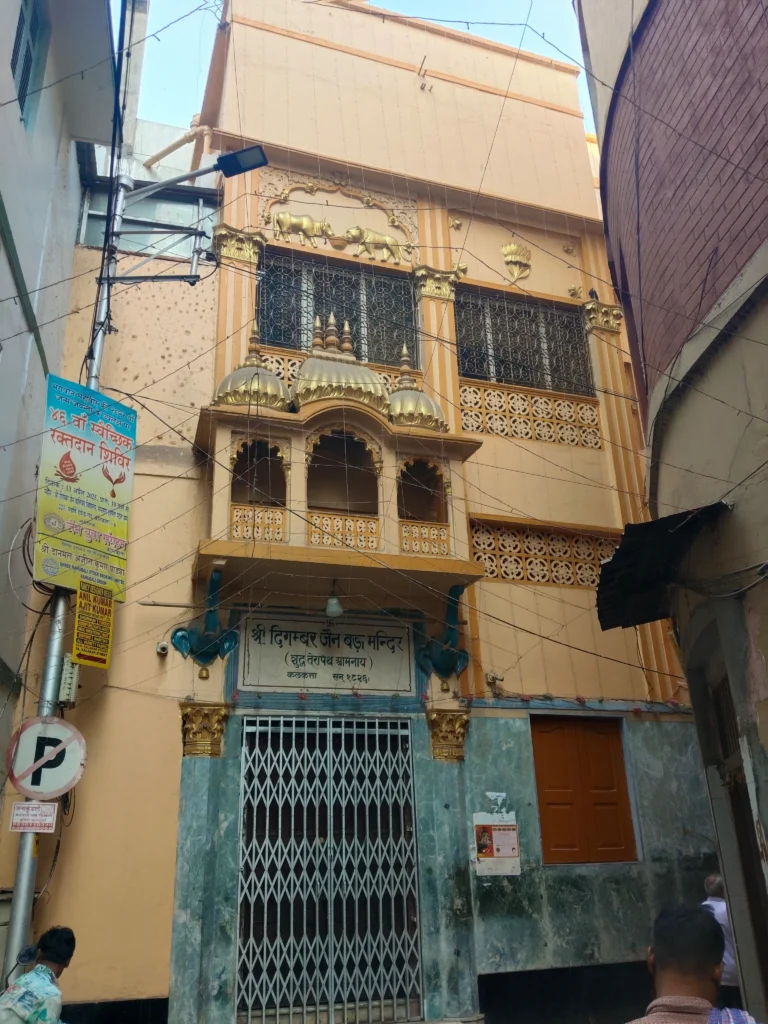
Tucked into a narrow Burrabazar lane, Sri Digambar Jain Bara Mandir exemplifies Marwari Jain temple architecture
Haveli–Godown Hybrids
The dominant building type combined shop, warehouse, and residence. Drawing on Rajasthani haveli traditions—internal courtyards, layered privacy, and vertical organisation—these structures adapted to the pressures of a congested colonial city. Narrow plots were built upward, with thick brick walls designed for storage rather than ornament. Function consistently outweighed façade.
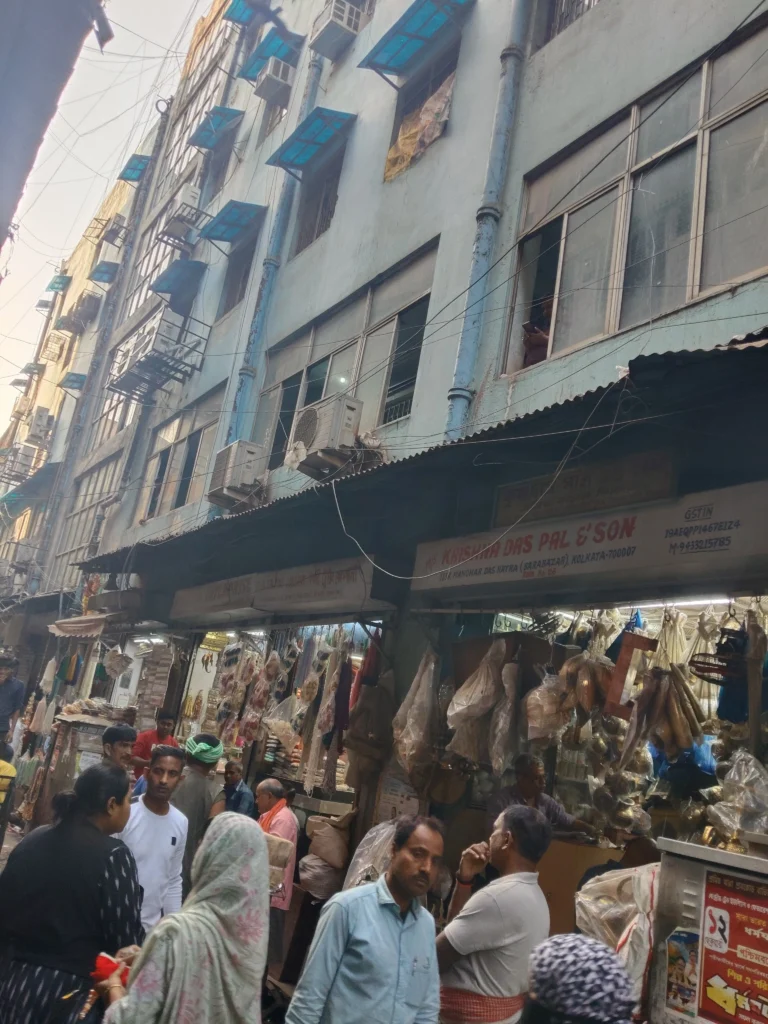
A lane of Burrabazar, bustling with activity
Temples in the Marketplace
Religious buildings formed another visible layer of Marwari presence. Temples dedicated to Krishna, Shyam, and Jain Tirthankaras stood within commercial lanes, embedding devotion in daily trade. These were not isolated sacred spaces but multifunctional institutions—sites of worship, arbitration, charity, and social coordination.
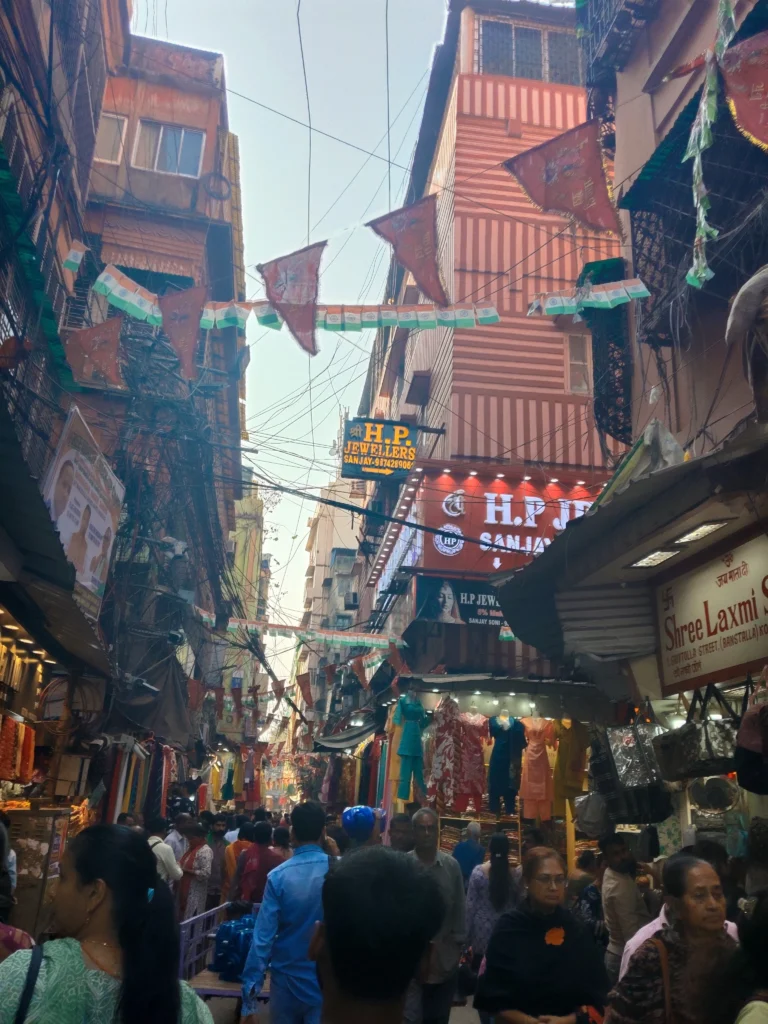
Bustling Manohar Das Katra Road hums with the timeless energy of Burrabazar’s trade and craftsmanship
Compact sanctums and modest exteriors concealed richly ornamented interiors. Inscriptions recorded donors, repairs after epidemics, and acts of collective philanthropy, underscoring religion’s role in sustaining commercial trust.
A Krishna temple in Burrabazar, for example, functioned simultaneously as shrine, meeting place, and informal court of mediation. Merchants gathered there before opening their shops; festivals doubled as occasions for food distribution and community solidarity.
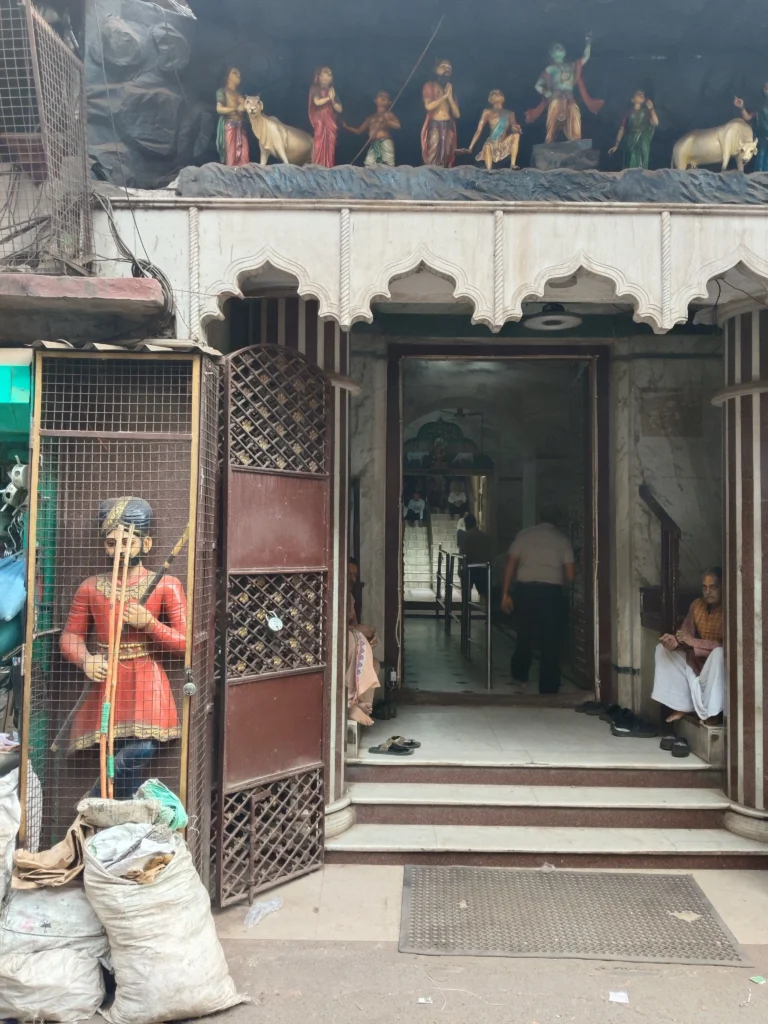
Sawaria Seth—an intimate Marwari shrine tucked between the commerce and chaos of Burrabazar2
Dharamshalas and Proto-Civic Institutions
Dharamshalas provided lodging for itinerant traders, pilgrims, and the poor. Funded through community trusts rather than individuals, they reflected collective responsibility. Such institutions reduced the costs of long-distance trade while reinforcing shared ethical norms.
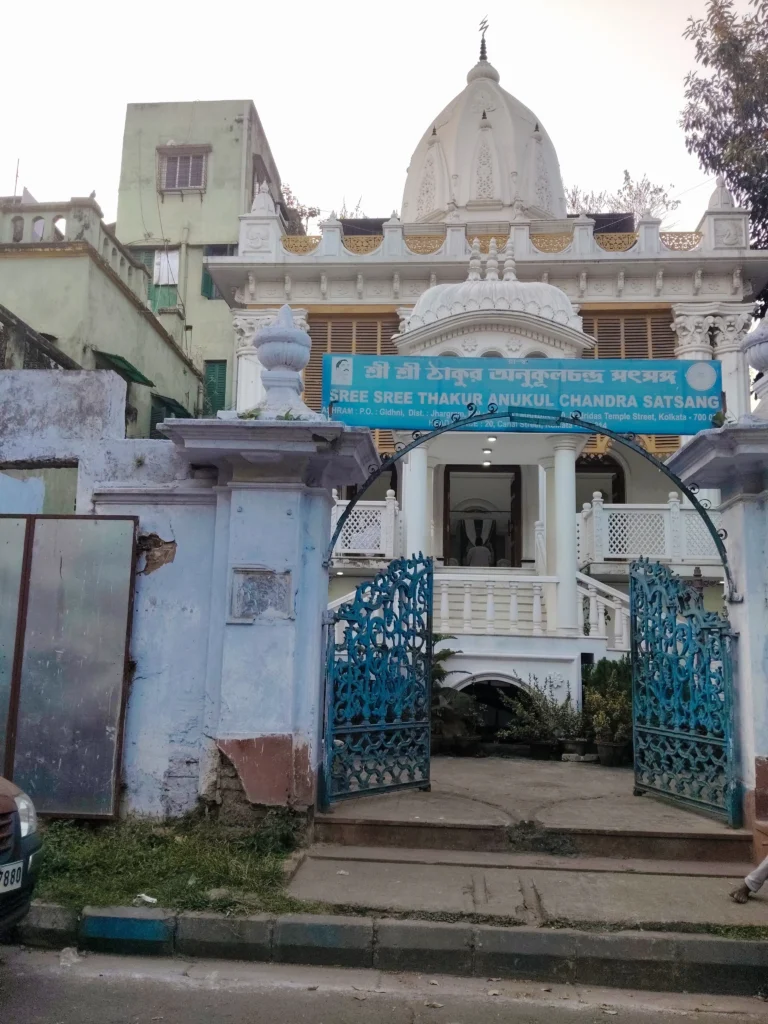
Founded in the early 20th century, the Sri Sri Thakur Anukul Chandra Satsang reflects the Anukul Thakur–led devotional reform movement in north Kolkata
Together, temples and dharamshalas acted as connective tissue linking Calcutta to Rajasthan, Banaras, and western India—sustaining circular migration and commercial continuity.
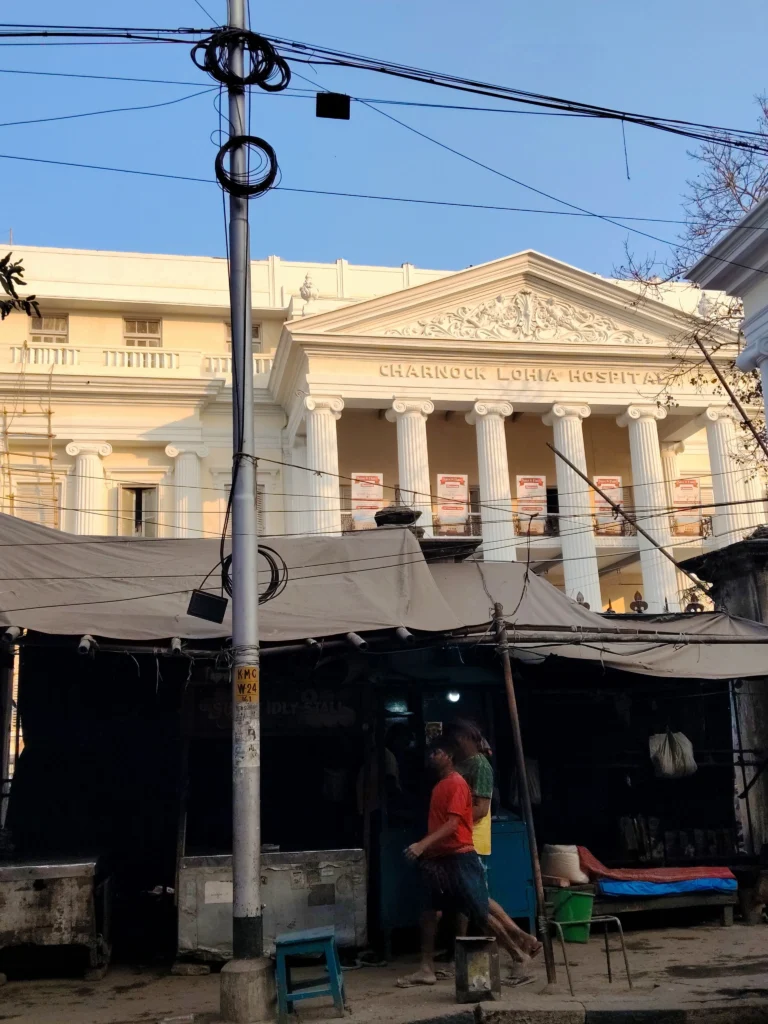
Charnock Lohia Hospital stands as a testament to the Marwari community’s enduring legacy of philanthropy in Kolkata
Burrabazar’s buildings embodied systems of credit, kinship, and ritual. They materialised merchant networks in brick and stone, transforming urban space into an infrastructure of trust.
Capital, Community, and the Making of a City
Histories of colonial Bengal have often privileged elite literary culture and administrative change, marginalising mercantile communities as merely economic actors. Yet examining food habits, ritual calendars, architecture, and business practice reveals how deeply these communities shaped urban experience.
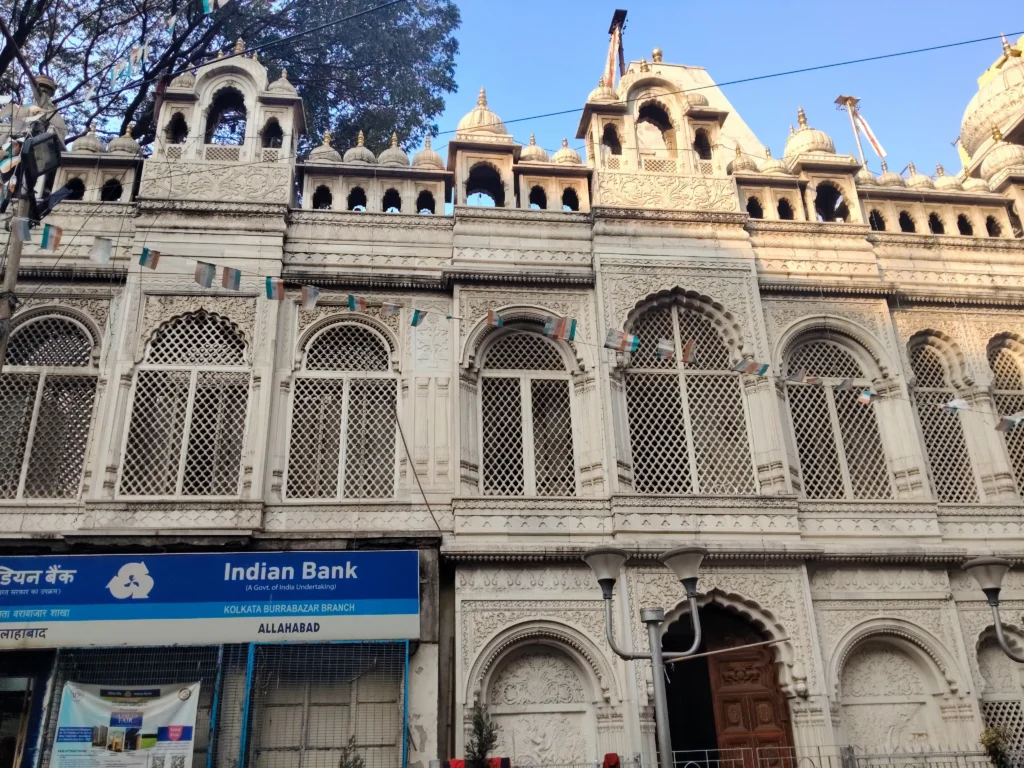
The Svetambar Jain Temple in Burrabazar dates to the late 19th century, reflecting a colonial-era fusion of Jain devotion and ornate Indo-European architecture
Marwari traders established a parallel culinary economy centred on vegetarianism. Eating houses clustered around Burrabazar and Posta catered to community preferences while attracting diverse clientele.[i] Dishes such as dal, bati, roti, and churma adapted to Bengali ingredients, incorporating mustard oil alongside ghee.
Sweet traditions travelled even more widely. Mohanthal, ghewar, and peda entered local confectionery repertoires, while malpua became a shared festive food. Cuisine followed trade routes rather than cultural boundaries.
Marwari ritual calendars reshaped neighbourhood time. Janmashtami celebrations spilled into public streets, while Jain observances such as Paryushan temporarily altered local markets, including the closure of meat shops near temples.[ii]
[i] Municipal licensing and urban administrative records noting concentrations of vegetarian eating houses in the Burrabazar–Posta area during the late nineteenth century.
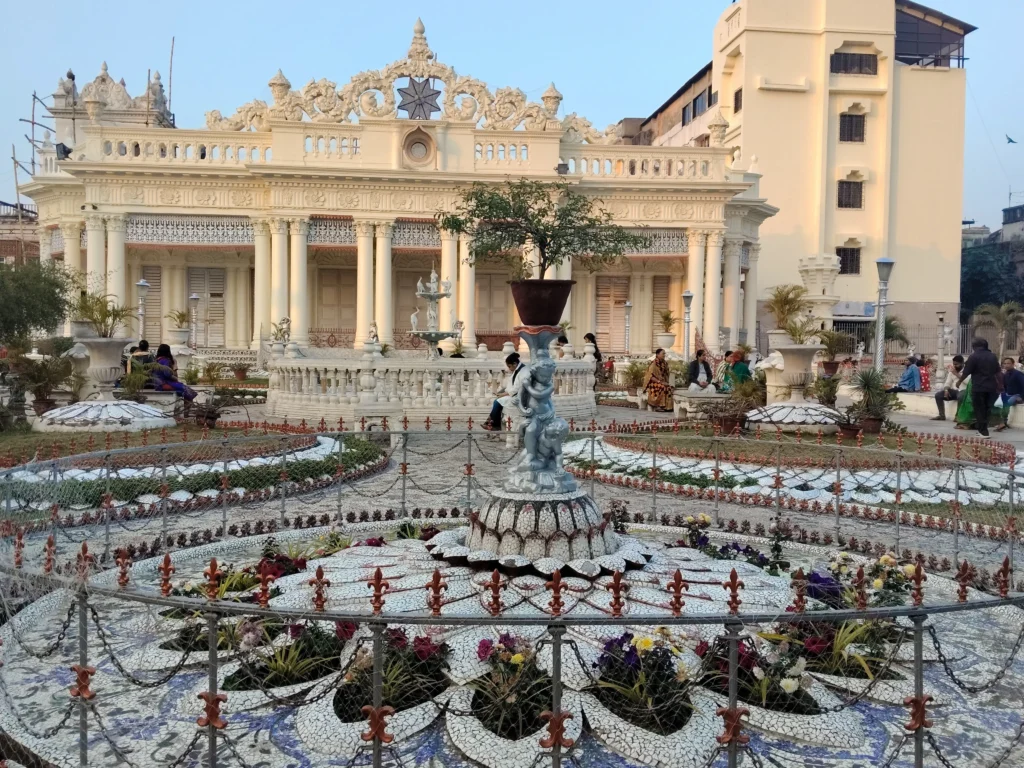
The Parashmani Jain Temple complex offers a rare oasis of calm, art, and devotion amid Burrabazar’s dense urban fabric
Other festivals—Gangaur and Teej—remained largely domestic but influenced women’s gatherings in nearby Bengali households. Minority customs gained visibility through repetition in shared spaces.
Practices such as khata-puja (ledger worship) during Diwali gradually spread among Bengali traders, sacralising accounting and trust. Short-term, interest-free credit systems circulated beyond Marwari firms, especially among small merchants operating in Burrabazar.
These customs functioned as cultural technologies stabilising commerce in competitive markets, complementing older Bengali traditions of philanthropy and educational patronage. Household practices—segregated courtyards, fasting rituals, and sattvic cooking—were selectively adopted by neighbouring families. Meanwhile, mercantile vocabulary entered colloquial Bengali: terms like seth, gaddi, bahi, rokda, and jama-kharch remain embedded in marketplace speech. Such exchanges reveal a form of everyday modernity shaped by sustained coexistence rather than assimilation.
Marwari engagement with the freedom movement unfolded in forms consistent with their commercial priorities. Rather than participating in street agitation, they supported nationalism through finance, philanthropy, and institution-building. Marwari industrialists funded the Indian National Congress, invested in Swadeshi enterprises, and sustained nationalist newspapers and schools, thereby embedding their capital within the emerging infrastructure of Indian self-reliance. This calibrated participation allowed them to align with Gandhian economic ideals while avoiding disruptions to trade and credit networks centred in Burrabazar. Such “backstage nationalism” strengthened their legitimacy as indigenous industrialists and civic patrons, helping transform a migrant mercantile community into an entrenched urban elite in colonial Calcutta.
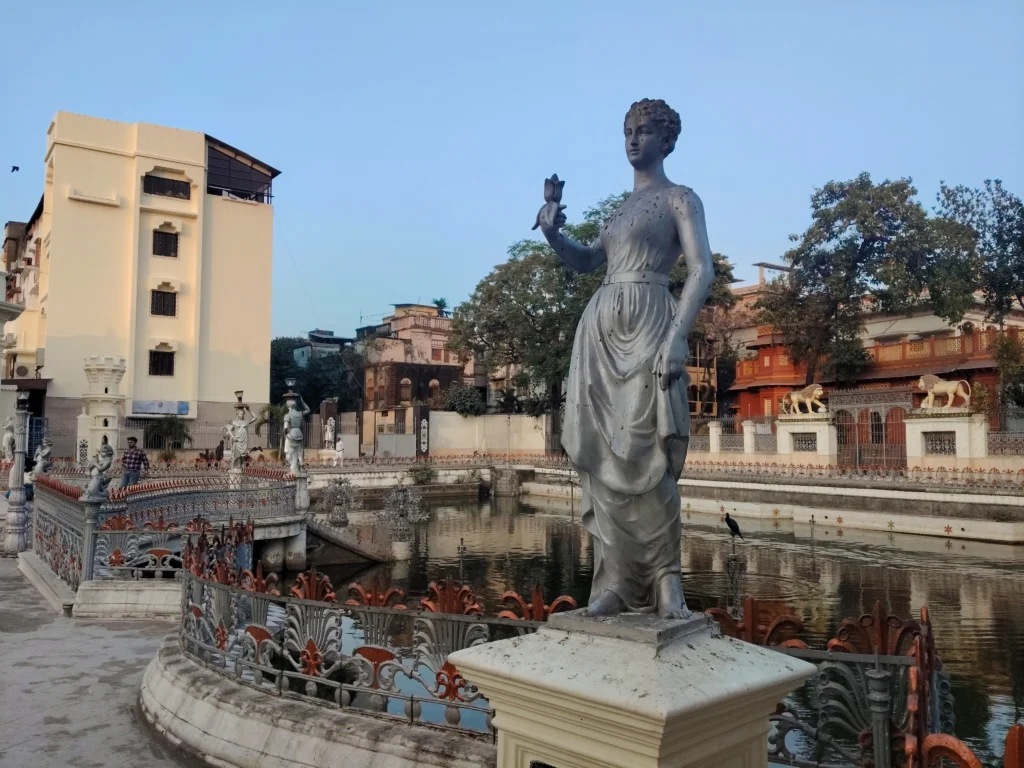
A classical European-style sculpture at the Parashmani Jain Temple reflects the cosmopolitan artistic vision of Burrabazar’s Jain patrons
Marwari contributions to colonial Calcutta were foundational. As traders, industrialists, patrons, and builders, they mediated imperial capitalism while sustaining autonomous networks that linked British territories to princely India. Their engagement with nationalism unfolded through finance and institution-building rather than mass mobilisation. The Marwari foothold in colonial Calcutta was secured as much through political prudence and institutional patronage as through markets and money. Their architecture transformed Burrabazar into a living system of commerce and community. Their customs reshaped everyday urban culture.
The story of colonial Calcutta is therefore not only one of imperial governance or Bengali intelligentsia, but also of merchant capital, trust-based networks, and adaptive cultural exchange. Nationalism itself was sustained as much by credit, philanthropy, and built space as by protest—an alternative geography of power forged in markets, temples, and counting houses.
Notes
[1] C.A. Bayly, Rulers, Townsmen and Bazaars: North Indian Society in the Age of British Expansion, Cambridge University Press, 1983.
[2] The brief Gwalior War was fought between the East India Company and the Scindia-ruled state of Gwalior in 1843. British victory secured paramountcy while allowing Gwalior to remain a semi-autonomous princely state under indirect rule. It stabilised central India without eliminating indigenous authority, creating the multi-jurisdictional landscape in which Marwari commercial networks flourished. That landscape channelled inland capital toward Calcutta, enabling Marwaris to become some of the city’s most powerful financiers, industrial investors, and urban patrons.
[3] Tirthankar Roy, The Economic History of India 1857–1947, Oxford University Press, 2011.
[4] Municipal licensing and urban administrative records noting concentrations of vegetarian eating houses in the Burrabazar–Posta area during the late nineteenth century.